When someone orders a license plate frame with a name, logo or lettering, they rarely think about how that lettering is actually made. Yet it's the production method that decides whether, two years on, the frame still looks like the day it was ordered — or starts to peel, lift and fade.
I'll be honest from the start — our workshop has almost every machine used to brand license plate frames. A plotter for cutting vinyl, a laser for raised lettering, a 3D printer. We know how each of these methods works, because we've tried them. And that's exactly why we offer UV print. Not because we can't do the others, but because it lasts the longest. Here's why.
The four ways to put lettering on a license plate frame
On the market you'll mainly find four approaches. Three of them share the same hidden weakness.
Cut PVC vinyl (plotter). The most common and cheapest method. The text is cut from colored vinyl and stuck onto the frame. It looks good at first, but the vinyl is thin and stuck on top — and anything stuck on can peel off.
Raised letters (laser). The letters are cut from polycarbonate or a similar material and glued onto the frame. The effect is more solid, more 3D, more premium-looking. But the fixing method stays the same — glue between two surfaces.
3D-printed lettering. Here the lettering is built up as a separate piece, which is then glued onto the frame. The most complex of the three, the most visually impressive. And again — the final step is gluing.
Notice the pattern? All three methods, however much they differ in complexity and price, end the same way: something gets stuck onto the frame. And glue is the weakest link.
Comparison of the four methods
| Criterion | UV print | Cut vinyl | Raised letters | 3D print |
|---|---|---|---|---|
| Fixing method | ✓ Directly into the material | Glue | Glue | Glue |
| Durability | ✓ 3+ years (personal test) | Fades within the first seasons | Glue gives way over time | Glue gives way over time |
| Fading from sun | ✓ Doesn't fade (UV varnish) | Fades visibly | The material itself doesn't fade, but the glue gives way | Depends on the material |
| Car wash | ✓ Fully resistant | The jet lifts the edges | The jet attacks the edge of the letters | The jet attacks the edge |
| Peeling / flaking | ✓ Impossible — no stuck-on layer | Flakes over time | The letters peel off | The whole lettering can fall off |
| Cold / heat | ✓ Resistant — no glue | The glue breaks down | The glue breaks down | The glue breaks down |
| Residue on removal | ✓ No residue — screw mounting | Leaves a glue layer | Leaves a glue layer | Leaves a glue layer |
| Selective varnish (matte/gloss contrast) | ✓ Selective UV varnish | No protective coating | No coating | Clear varnish only |
| Price | ✓ €16.90 per set | Lower, but replaced more often | Higher | Highest |
Why what's glued comes unglued
The license plate frame lives in one of the most hostile spots on the car. In summer, the metal and plastic up front heat up to temperatures that soften glue. In winter, the cold makes it brittle. In between — sharp temperature swings every time a cold engine starts.
Then comes the car wash. Touch-free detergents are aggressive chemicals designed to dissolve grease and grime — and along with them they attack the edge of every glued-on element. High-pressure jets finish the job: a pressurized stream aimed under the edge of a vinyl or letter sooner or later finds the weak spot and starts to lift it.
The result after a year or two is familiar to everyone — vinyl with lifted edges, a raised letter hanging by one corner, dust and moisture gathered under the lettering. Not because the workmanship was poor, but because the method itself has an expiry date.
What makes UV print different
UV print sticks nothing onto the frame. The ink is applied directly onto the material and cured instantly with ultraviolet light — hence the name. The result isn't a stuck-on layer but a print that's part of the surface. There's no edge to lift. There's no glue to soften in heat or crack in cold. There's nothing to peel off, because nothing is stuck on.
This completely changes the durability equation. The touch-free detergent has no edge to attack. The jet passes over a smooth surface, not under a lifted edge. Temperature swings don't act on a glue layer, because there isn't one.
A real test: my car, three years on
I won't quote lab data I didn't produce myself. I'll tell you what I see every day.
The frames on my own car are made with UV print and have been on it for three years. Over those three years they've been through everything — summer heat, winter cold, countless car washes with pressure jets and touch-free detergents. The result: not a single chipped spot, nothing peeled, nothing faded. The colors have kept their brightness exactly as on the day I fitted them.
Three years isn't a marketing number — it's the real mileage of a real car I wash like any other. And that's why, when I choose what to offer a customer, I choose what I drive myself.

The final detail: the UV varnish
There's one more layer most people don't see but do feel — the partial UV varnish.
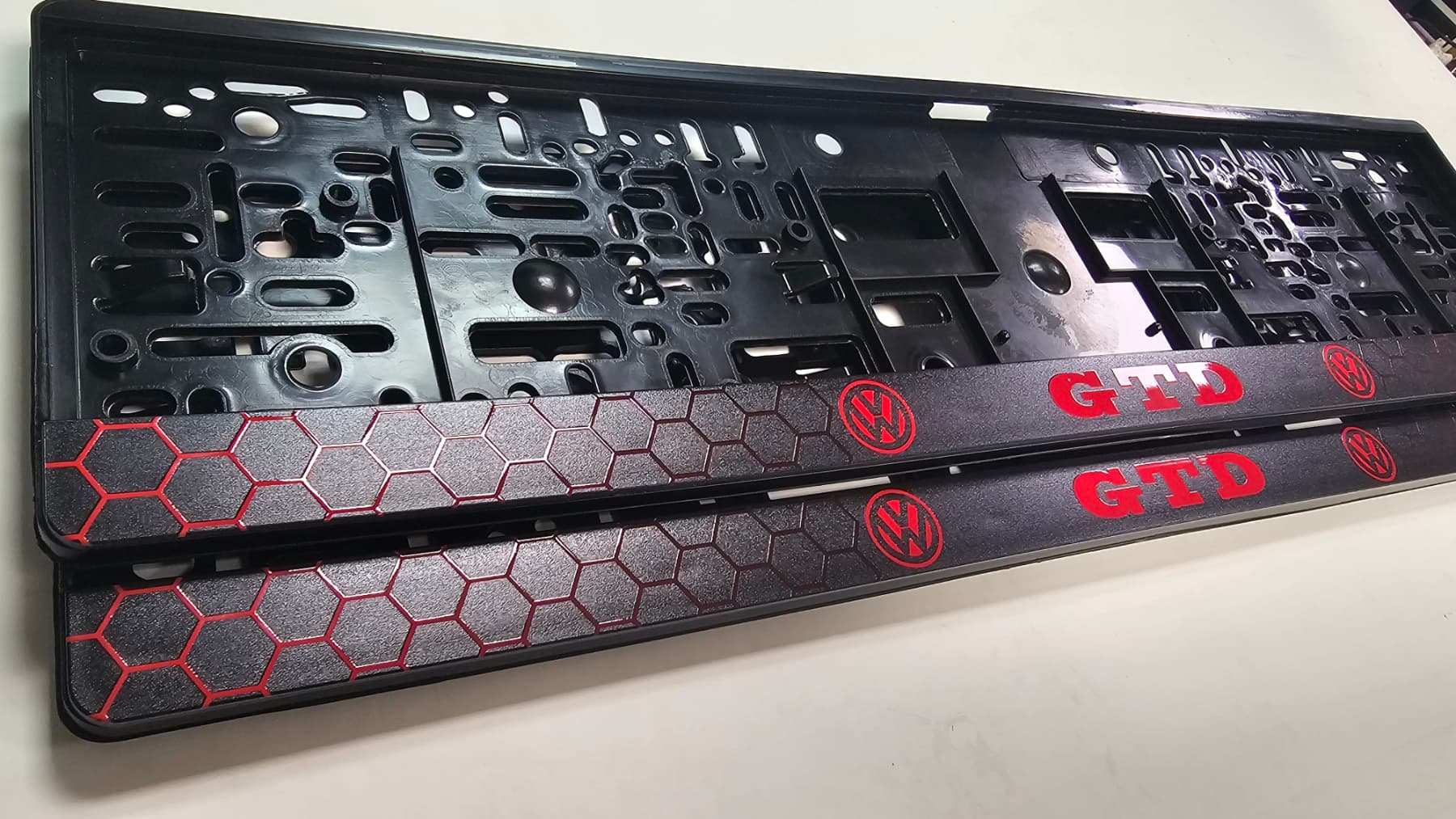
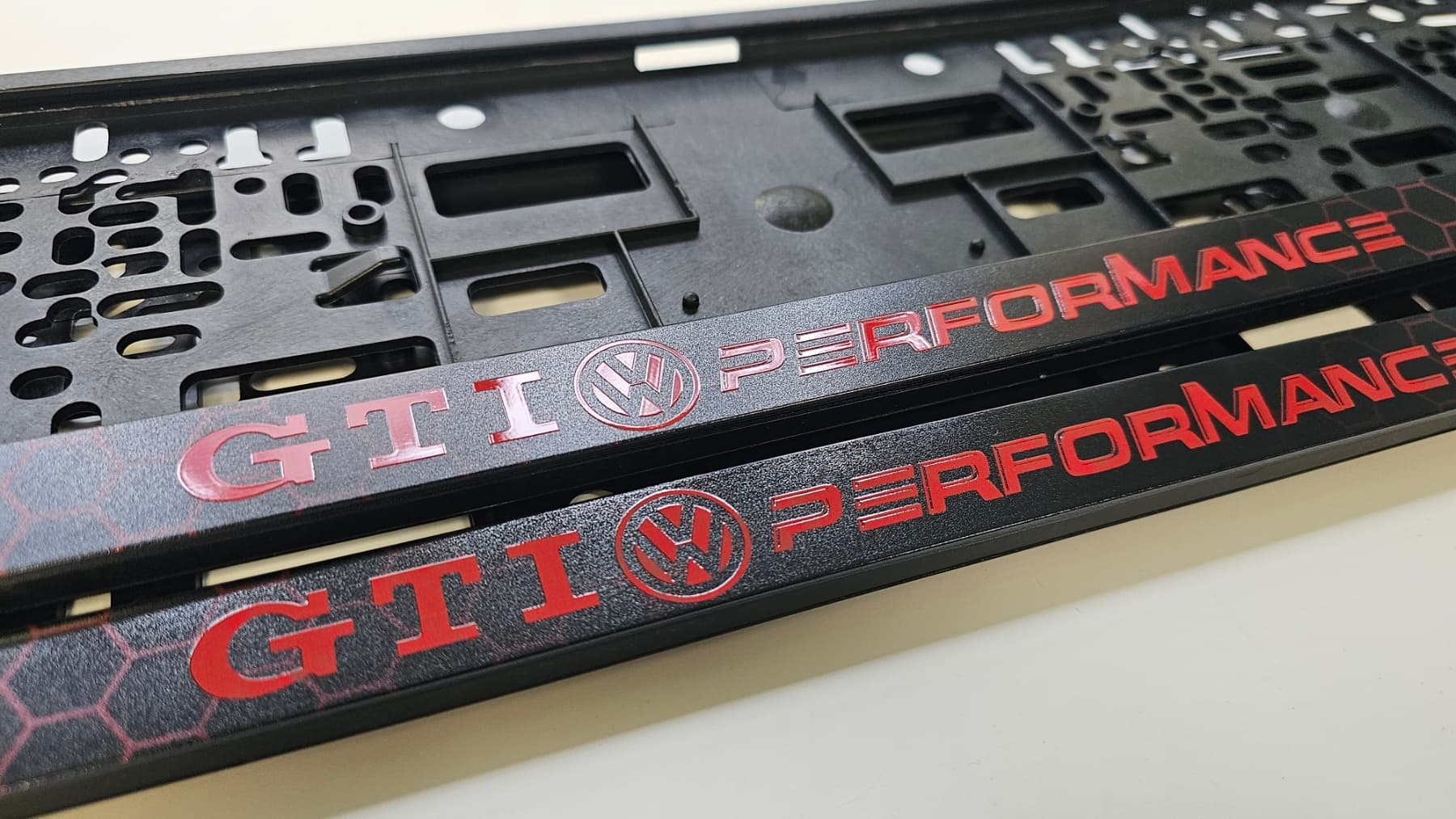
When the frame has a full printed background with text or a logo on it, we apply varnish selectively — only on the elements we want to stand out. This emphasizes the lettering, makes it crisper and adds a depth that flat printing lacks.
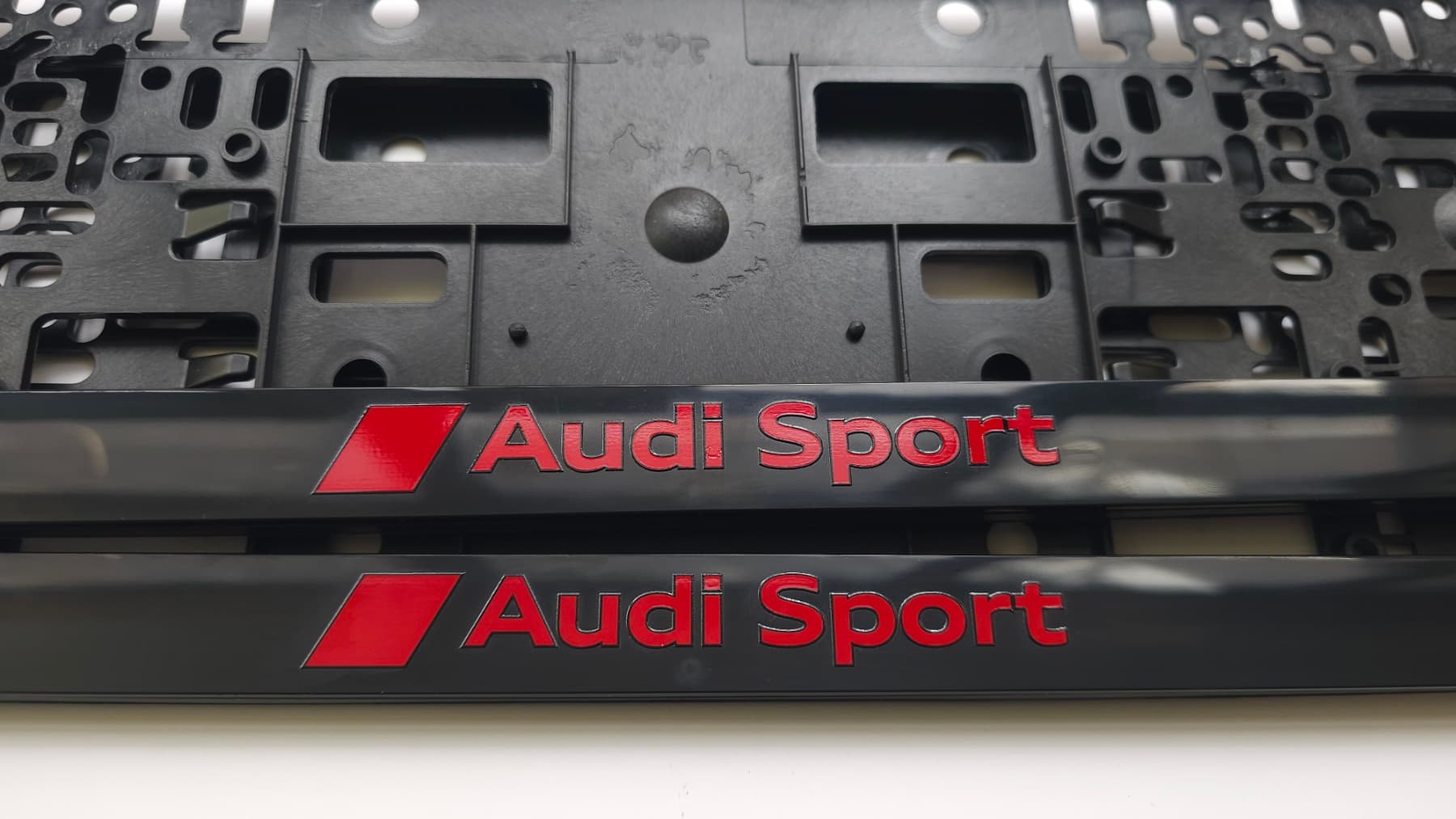
When the frame has a simpler inscription — say just a name or a model like “Audi Sport” — we apply the varnish over the whole text. Then it plays a double role: it gives a beautiful gloss and adds another protective layer over the print. The result is lettering that both shines and is protected.
Selective UV varnish: matte background, lacquered elements
The technique is called spot UV or selective varnish and comes from premium printing — business cards, luxury packaging, cosmetics. The principle is simple: the varnish is applied not everywhere, but only where it needs to stand out.
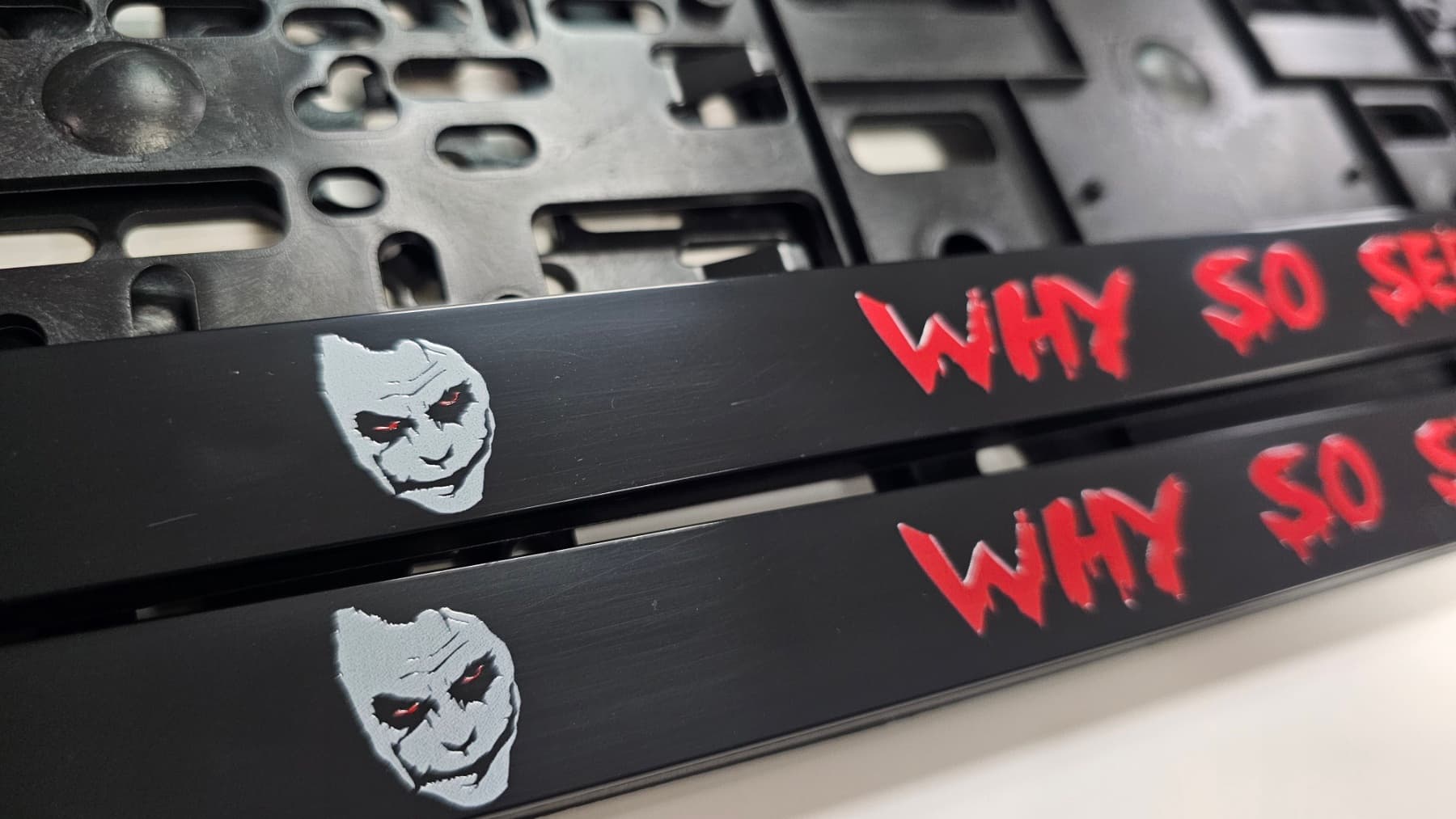
On our frames the varnish covers exactly the printed elements — logos, texts, graphics. They become glossy, more saturated and slightly raised to the touch. On designs with a full or partial background, the background stays smoothly matte. The matte–gloss contrast is clearly visible at an angle of light and felt with a finger — something neither a sticker nor ordinary print can reproduce, because with them everything is one and the same layer, with no difference in texture.
It's exactly this difference — lacquered elements set apart from the matte background — that gives the frame a finished, premium look, different from anything glued. The UV varnish also adds extra protection to the printed elements against UV rays and mechanical wear.
Browse frames with lacquered elements →
That's the difference between a product that just looks good in the photo and a product that looks good even after three years on the road.
Which to choose
If you're after the cheapest for a short period — cut vinyl does the job. If you want something that lasts years without peeling, fading and upkeep, the choice is clear. That's why, with all the equipment at our disposal, we offer UV print — a set of two frames at €16.90, made to your design.
Create your design
€16.90 for a set of 2 frames with UV print and UV varnish. Econt delivery in 2–3 business days.